The MOVE Act Explained: Could You Really Keep Your Mortgage Rate When You Move?
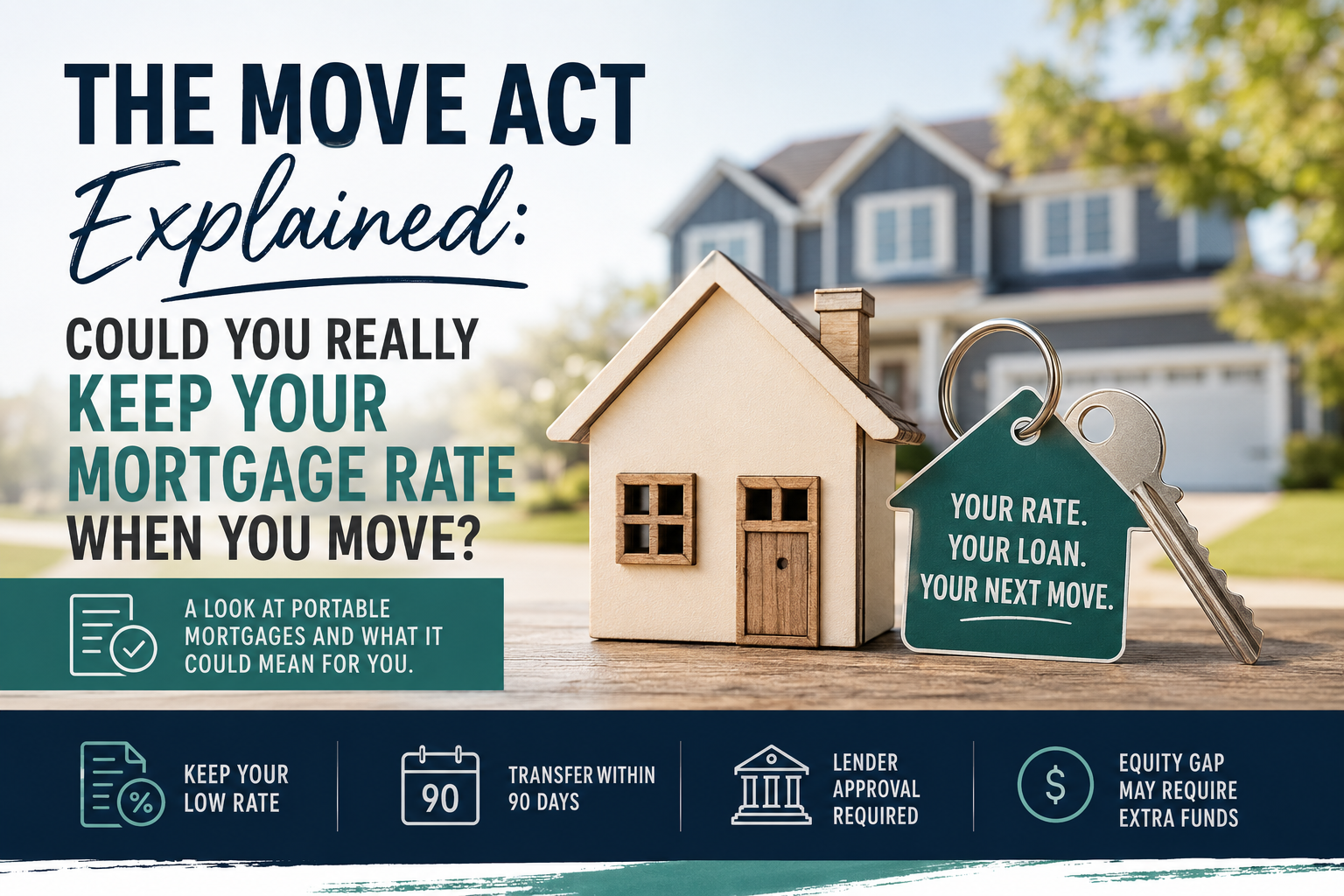
Imagine selling your house, buying another one, and taking your 3% mortgage rate with you.
For homeowners who bought or refinanced when mortgage rates were historically low, that probably sounds almost too good to be true.
That's the idea behind recent discussions surrounding portable mortgages—allowing homeowners to transfer an existing mortgage, including its interest rate and remaining balance, from one property to another.
You may have seen this idea referred to online as the MOVE Act or "Making Ownership Viable for Everyone Act." There's one very important distinction homeowners need to understand:
You cannot currently transfer your conventional mortgage rate to another house simply because you're moving, and homeowners should not make buying or selling decisions assuming proposed portability legislation will become law.
I'm Christina Paramore, Realtor® with The Paramore Group at eXp Realty, and here's what homeowners and buyers should understand about mortgage portability, why the idea is getting so much attention, and what it could actually mean for the Northeast Ohio housing market if something like it eventually becomes reality.
WHY WOULD PORTABLE MORTGAGES MATTER?
Millions of homeowners financed or refinanced during the era of extremely low mortgage rates.
Now imagine someone with a 3% mortgage considering selling their $300,000 home and buying a $400,000 home.
The problem isn't necessarily the price of the next house.
It's replacing that inexpensive mortgage.
Current HomeownerCurrent MortgageNew MortgageMortgage balance$200,000$300,000Example interest rate3%6.5%Rate difference—+3.5 percentage points
Illustrative example only; actual payments and rates vary.
Giving up a low rate can dramatically change the economics of moving.
That's one reason homeowners sometimes tell me, "I'd move, but I'm not giving up my interest rate."
And I understand it.
But homeowners should look beyond the rate. If your current home no longer works for your family, commute, lifestyle, maintenance needs, or financial goals, staying solely because of a mortgage rate has a cost too.
HOW WOULD MORTGAGE PORTABILITY WORK?
The basic idea is fairly simple:
Instead of paying off your existing mortgage when selling and obtaining an entirely new mortgage for the next property, an eligible homeowner could potentially transfer some or all of the existing financing to the replacement home.
Think of it as moving the mortgage financing along with you.
But there's a major issue that gets overlooked in social-media explanations:
Your mortgage balance doesn't magically increase.
Let's say:
ScenarioAmountNew home purchase$450,000Portable mortgage balance$200,000Equity/cash available$150,000Remaining financing needed$100,000
You still need to solve that $100,000 gap.
Depending on how a future portability program were structured, that could potentially require additional cash or supplemental financing at then-current market rates.
This is why I'd never advise someone to compare mortgage rates alone. We need to compare the entire financial picture.
THE "GOLDEN HANDCUFF" PROBLEM
Low mortgage rates have created what the real estate industry often calls the lock-in effect.
Homeowners aren't literally prevented from selling. Economically, however, replacing an inexpensive mortgage with a more expensive one can make moving significantly less attractive.
That affects more than individual homeowners.
It potentially affects housing inventory.
If someone doesn't sell their starter home because they don't want to lose a 3% mortgage, that home never becomes available to the next first-time buyer.
Then the owner doesn't purchase the move-up home.
One decision can ripple through multiple levels of the housing market.
Potential benefits of portability
✓ More homeowners may consider moving
Homeowners could make housing decisions based more on lifestyle and less on protecting an interest rate.
✓ More existing homes could reach the market
Additional inventory could provide buyers with more choices.
✓ Downsizers could have greater flexibility
Homeowners who want less maintenance might be more willing to sell.
✓ Growing families could move up sooner
A family that has outgrown its current home might not feel as financially trapped by its existing mortgage.
But portability isn't automatically a housing-market cure.
THE PART MOST HEADLINES LEAVE OUT
There would be substantial practical questions to resolve before widespread mortgage portability could work in the United States.
QuestionWhy It MattersWhich mortgages qualify?Not every loan is structured identicallyHow is the new property underwritten?The lender still needs acceptable collateralDoes the borrower requalify?Income, credit and debt may have changedWhat happens when buying a more expensive home?Additional financing may be necessaryHow are mortgage investors affected?Existing loans are often packaged into securitiesHow quickly must someone buy again?Timing could affect eligibilityWhat happens with divorce or joint borrowers?Ownership and qualification become complicatedCan portability cross state lines?Program rules would need to address it
That's why I wouldn't make a real estate decision today based on the assumption that mortgage portability is coming.
Interesting policy proposal? Absolutely.
Something you can use to buy your next house today? No.
WOULD KEEPING YOUR RATE AUTOMATICALLY MAKE MOVING AFFORDABLE?
No—and this is probably the most important part for homeowners.
Suppose you've accumulated substantial equity.
You might discover that selling your current home and putting that equity into the next property makes your new payment more manageable than expected—even at today's mortgage rate.
That's why I encourage homeowners to run an actual sell-and-buy analysis rather than comparing interest rates.
Look at:
Estimated sale price
Current mortgage payoff
Estimated selling expenses
Available equity
New purchase price
Down payment
New mortgage amount
Taxes
Insurance
HOA fees
Expected maintenance
Monthly payment
Sometimes homeowners who feel "trapped" by their mortgage discover they have more options than they thought.
Your 3% rate is valuable. But your equity may be valuable too.
SHOULD YOU WAIT FOR MORTGAGE PORTABILITY BEFORE MOVING?
I wouldn't build a real estate strategy around legislation that doesn't currently provide you with a usable financing option.
Instead, compare the choices available right now.
OptionAdvantageTrade-OffStay in current homeKeep existing mortgageHome may no longer fit your needsSell and buy nowMove forward with life plansNew financing may cost moreUse more equityReduce new mortgageLess cash remains availableBuy down the ratePotentially lower paymentRequires upfront fundsNegotiate seller concessionsMay reduce financing costsDepends on property and marketWaitMarket/rates could improvePrices, rates and inventory could also move against you
There's no universal right answer.
The mistake is assuming that waiting is free.
If home values increase while you're waiting for mortgage rates to fall, you could save on interest but pay significantly more for the house.
That's why I evaluate the entire transaction rather than trying to predict one number.
WHAT COULD THIS MEAN FOR NORTHEAST OHIO?
Mortgage portability could be particularly interesting in markets like Medina County, Cleveland, Lorain County and surrounding Northeast Ohio communities.
We have many homeowners who purchased or refinanced during the low-rate years and have since accumulated substantial equity.
Some want to move but hesitate because of financing.
If a workable portability program were ever implemented, it could potentially unlock some of those homes.
That could create opportunities at multiple price points.
More starter homes could become available.
Move-up buyers could become active again.
Empty nesters might feel more comfortable downsizing.
But increased buyer mobility could also create additional competition for desirable homes.
More inventory doesn't necessarily mean lower prices if portability also creates more buyers.
That's an important part of the equation that often gets missed.
WHO IS CHRISTINA PARAMORE?
I started my real estate career in 2007 and today serve Northeast Ohio through The Paramore Group at eXp Realty, with a strong focus on Medina County, Cleveland, Lorain County and surrounding communities.
My experience includes buyers, sellers, relocation clients, investors, short sales, foreclosures and transactions ranging from straightforward to extremely complicated.
I've worked through very different housing and interest-rate environments.
And one lesson remains consistent:
Don't make a real estate decision based solely on headlines. Make it based on your numbers.
That's especially true with something like mortgage portability.
The concept could be significant if enacted in a workable form. But until an actual program becomes available to homeowners, your buying and selling strategy needs to be based on the financing options and market conditions available today.
THINKING ABOUT MOVING BUT DON'T WANT TO LOSE YOUR LOW RATE?
This is becoming one of the most common conversations in real estate.
And my answer isn't automatically, "Sell."
Sometimes staying makes sense.
Sometimes moving makes more sense than homeowners realize.
The first step is figuring out:
What could your current home sell for?
How much equity would you walk away with?
What would the next home actually cost you per month?
Once we have those numbers, we can compare staying versus moving instead of guessing.
I'm Christina Paramore, Realtor® with The Paramore Group at eXp Realty, serving Medina County, Cleveland, Lorain County and communities throughout Northeast Ohio.
If you're considering moving but feel trapped by your current mortgage rate, let's run the numbers first. You may have more options than you think.